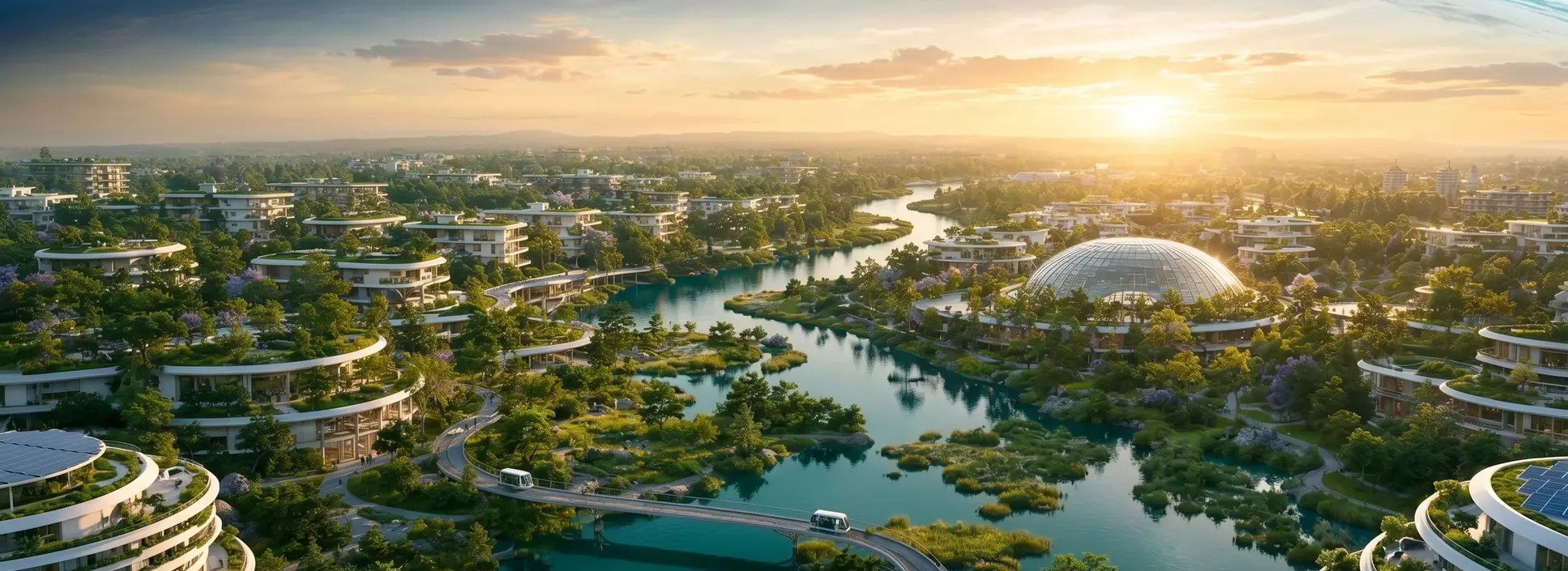
The Economy Doesn’t Work for Everyone.
There’s Another Way.
Rent eats the paycheck. Wages are taxed before you ever see them. Meanwhile, fortunes are made by simply owning property and assets. None of this has to be this way — there is another way, and it’s already working in the real world.

What’s Broken
You work hard. So why does it feel impossible to get ahead?
In major cities around the world, an average home now costs 8 to 12 times an average yearly income — a generation ago it was 3 to 4.1 At a 10% savings rate, a downpayment that once took 6 to 8 years to save now takes 16 to 24 years(!) — and that’s if prices stand still while you save… and if you can save at all.
And the downpayment is only the entry fee: at today’s prices, the mortgage on the rest would swallow half a typical paycheck — a loan most banks won’t even write. Owning a home increasingly depends not on what you earn, but on what your parents own.
Renting is no refuge: rent routinely takes a third or more of a paycheck.2 A full-time job no longer guarantees a place to live.
Work is punished.
Income taxes fall on effort: the harder you work, the more is taken. Sales taxes raise the price of everyday essentials — costing you more money, precisely when you have less money to spend.
Hoarding is rewarded.
When a neighborhood grows, the price of its land soars. The owner gains without lifting a finger, and empty lots become winning investments — while families are priced out.
Paychecks become interest.
Higher land prices mean bigger mortgages, so decades of paychecks flow to interest — feeding on value that communities created. Most bank lending no longer funds businesses and productive activities; it funds ever-larger loans against the same amount of land.3
Nature also pays the price.
When land is treated as a private commodity to trade for profit, it’s sprawled over, stripped, and speculated on as if the living world were worthless. We’ve forgotten how to live in harmony with the nature that sustains us.
These aren’t separate problems. They all trace back to a single design flaw at the base of our economy — and because it’s a design flaw, it can be fixed. Correct it, and the same forces that now drain prosperity begin to build it instead.
The Cure
Every plot of land has a rental value — what it would fetch on the open market, no matter who owns it. That value isn’t created by the owner. It’s created by the whole community: the roads, the schools, the businesses, the neighbors. The cure is simple: communities fund themselves from that land value instead of taxing work.
When holding land idle costs its fair rental value, speculation stops paying. Land prices fall toward what land is actually worth to use. Homes cost closer to what they cost to build. And because wages and buildings go untaxed, working and building are rewarded again.
Keep what you earn.
Wages and buildings come from human effort. They go untaxed — work and enterprise are rewarded, not penalized.
Share what nature provides.
Communities collect the rental value of land — value the community itself creates through its growth and public investment.
Invest in everyone.
That revenue funds schools, hospitals, roads, and clean water — or is paid out directly to citizens, like a dividend, so everyone shares in the community’s wealth.
Tested in the Real World
This is not a new theory. It already works.
Denmark
Denmark has taxed land values since 1902.4 Every municipality collects grundskyld — a charge on the bare land, not the buildings on it — helping fund one of the world’s most prosperous and equitable societies for over a century.
Norway
Revenue from oil flows into a national pension fund that belongs to all Norwegians — now one of the largest in the world. Today, each citizen’s share is worth over USD $300,000.5
Singapore
Most land is publicly owned and leased. Even in one of the world’s most expensive cities, that land revenue funds quality public housing — home to about 8 in 10 Singaporeans6 — at prices far below the private market, while taxes on work stay low.
Alaska
The state shares its oil wealth directly: every resident receives a yearly dividend from the Alaska Permanent Fund.7
Canberra, Australia
Australia’s capital is doing it right now: a 20-year reform is replacing stamp duty with land-based rates, and from 2026 first-home buyers pay no stamp duty at all — a first in Australia.8 Taxes on buying and building fall as land value funds the city.
Allentown, Pennsylvania
Since 1996, this once-declining industrial city has taxed land at roughly five times the rate on buildings. Building permits rose 32% as idle lots turned into homes and businesses9 — growth its neighbors didn’t see.
Estonia
Estonia has taxed only land — never the buildings on it — since 1993.10 Construction and renovation go unpunished, speculation finds no shelter: the cleanest modern example of a national land value tax.
Real Estate Speculation
In 1997, economist Fred Foldvary predicted a major financial crash in the United States around 2008 — over a decade in advance — by studying land speculation cycles.11 He was right. Economies that share land value avoid these destructive booms and busts.
What Prosperity Looks Like in Daily Life
A home you can afford.
Homes cost closer to what they cost to build, so a family can own one on an ordinary income — and put savings toward a life, not just a mortgage.
Strong public services, light taxes on work.
Land value funds schools, transit, and healthcare — so you keep more of every paycheck, and enterprise is freed to grow.
A stable economy.
Most financial crises begin with land speculation.12 Sharing land value removes the fuel — leaving steadier markets to build, hire, and invest in.
Nature protected.
When using land has a fair price, no one wastes it — cities grow richer and more livable, and the wild places we love stay wild.
Go Deeper
Explore the ideas behind Unitism — interactively, in depth, or at a glance.
In-Depth Guides
Plain-language explainers, from land-use rights to why housing is unaffordable.
Open →Glossary
Every key term — economic rent, land value, and more — defined simply.
Open →The Science
Peer-reviewed research behind the ideas — from land economics to ecology and peace.
Open →The Game
Take office as mayor, choose how your city pays for itself, and watch the economics play out.
Open →Interactive Tools
Play with simple models that reveal how land shapes the economy.
Open →FAQ
Short, clear answers to the questions people ask most.
Open →Our Role: From Idea to Implementation
Unitism exists to put this cure into practice. We work with governments, cities, and organizations on the concrete steps: assessing land values, designing the policies that collect them, modeling who gains and who pays, and seeing the transition through — step by step, until it’s working.
The thinking behind this work is not new. It builds on the classical economics of Adam Smith, David Ricardo, John Stuart Mill, and Henry George, and on modern economists including Fred Foldvary, Mason Gaffney, and Fred Harrison. Unitism was founded by Martin Adams, author of Land: A New Paradigm for a Thriving World.